GEO Myths: What's Actually True About Visibility in ChatGPT and Google AI Overviews
Most advice on AI search visibility has not been tested beyond the lab. When independent researchers study what actually drives citations in ChatGPT, Google AI Overviews, and Perplexity at scale, the findings contradict a large share of what is currently sold as GEO (Generative Engine Optimization) strategy. Six claims stand out as particularly widespread and particularly unsupported by the evidence.
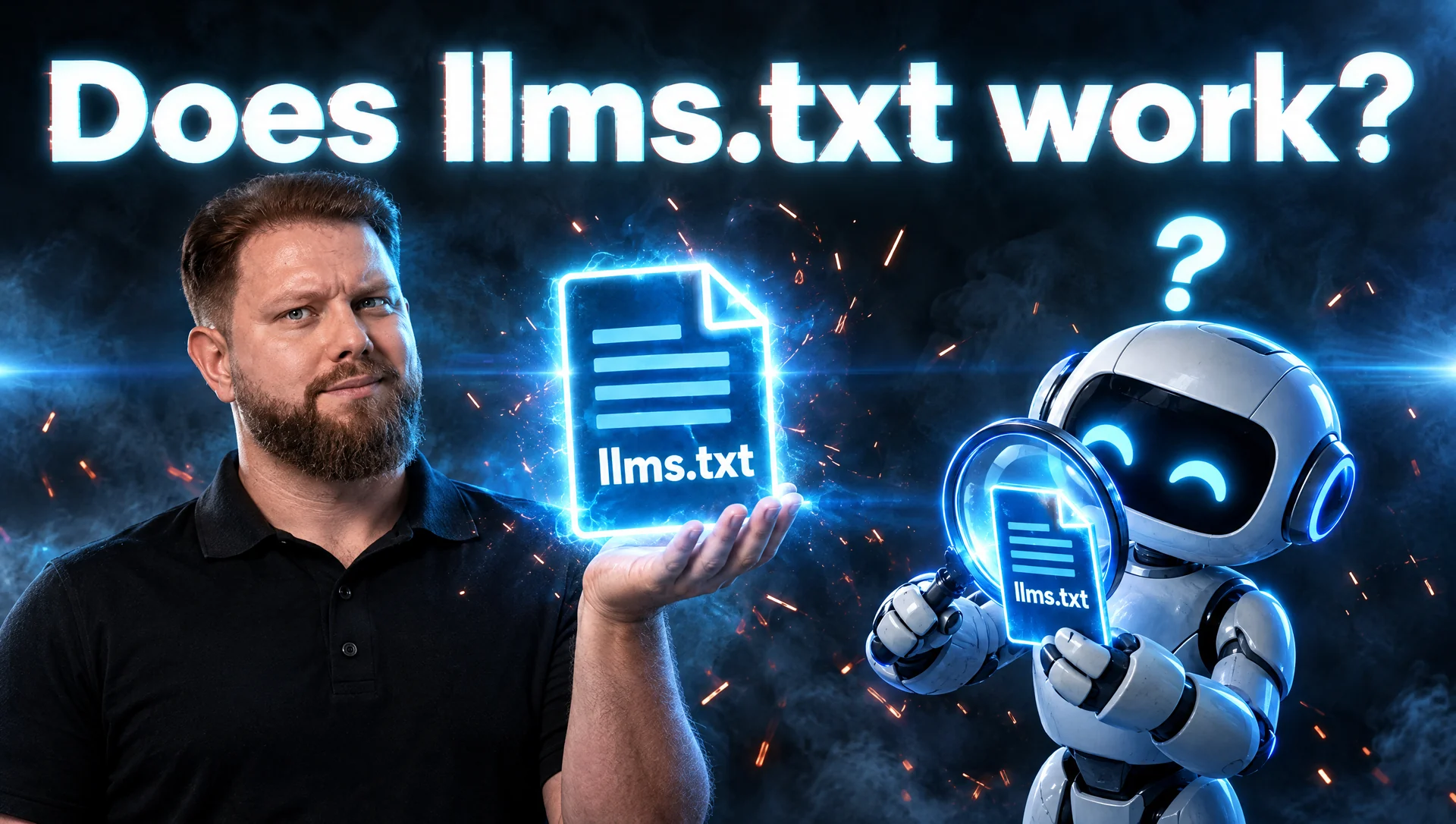
Does llms.txt improve your visibility in AI search?
No. Ahrefs analyzed server logs from 137,210 domains in May 2026 and found that 97% of valid llms.txt files received zero traffic that month. Among the small fraction of files that did attract any requests, AI retrieval bots (the category that includes PerplexityBot and OAI-SearchBot) accounted for only 1.1% of requests (Ahrefs, May 2026). Google confirmed separately that it does not use the file for search at all.
The file format remains a proposed standard, not an adopted one. Maintaining a llms.txt is harmless. Treating it as an AI visibility signal wastes time better spent on factors the research actually supports.
Does schema markup lead to AI citations?
Barely, if at all. Ahrefs tracked 1,885 pages that added JSON-LD schema between August 2025 and March 2026 and measured their AI citation rates before and after. The results: Google AI Overviews showed -4.6% (not attributable to schema, reflecting broader platform trends), Google AI Mode +2.4%, and ChatGPT +2.2%, both statistically indistinguishable from zero (Ahrefs, May 2026). Schema remains useful for traditional rich results in Google Search, such as star ratings and event listings. It does not appear to influence citation rates in AI-generated answers.
The 53% of AI-cited pages that do use schema are not cited because of their schema; they tend to be sites that invest broadly in technical SEO, content quality, and authority building.

Does AI search need special optimization?
Not according to Google. The company's official documentation states: "There are no additional requirements to appear in AI Overviews or AI Mode, nor other special optimizations necessary" (Google Search Central, 2026). Both features build on the same index and ranking signals as standard search. Pages that already rank well and earn snippets in regular results are the ones that appear in AI-generated answers.
This matters for how you allocate resources. Agencies currently offering dedicated "GEO audits" and "AI-native content rewrites" as a distinct service are, in most cases, applying search engine optimization principles under a newer name. The underlying work is the same; only the framing has changed.
Do statistics and quotes give you 40% more AI visibility?
That figure comes from a controlled lab setup, not from production data. The claim traces to the original Princeton GEO paper, which tested a fixed set of queries with pages already present in the context window. A 2026 survey of 45 GEO studies (Martinez, arXiv, 2026) found that the original study's gains are "valid within its experimental setting but conditional on a source already being present in a fixed context." In competitive conditions, individual optimization gains erode. More importantly, "citation-oriented rewrites can impair retrieval." Adding well-sourced statistics can improve a page's quality. Claiming a fixed percentage uplift misrepresents how production AI systems behave.
Do FAQ blocks and author boxes lead to citations?
Not in isolation. Mahe Chen and Nick Koudas at the University of Toronto analyzed 468,037 citations across two markets in October 2026 (arXiv, 2026). Their finding: FAQ blocks, schema markup, author boxes, and summary boxes show no meaningful citation benefit when comparing pages within the same website. What correlates with citations is title relevance (+14.1% per standard deviation) and best-paragraph relevance (+15.5%). The engine's internal search ranking explains 32% of citation variation; on-page formatting explains only 2.8%.
Structural elements may still improve reader experience, but they are not what places your page in an AI answer. The two factors that matter are ranking well and having the clearest direct answer to the user's question at the top of the page. For a fuller picture of how AI systems source their answers, see how AI answers surface content.
Are backlinks the main lever for AI visibility?
No. Brand mentions are more important. Ahrefs analyzed 75,000 brands with Domain Rating above 40 and measured the Spearman correlation between various signals and AI Overview appearances (Ahrefs). Brand web mentions scored 0.664. Backlinks scored 0.218, roughly one-third as strong. Branded anchor text (0.527) and branded search volume (0.392) also outperformed traditional link metrics.
Domain Rating and referring domains still appear in the data at 0.326 and 0.295 respectively, so links are not irrelevant. The signal composition is simply different from classic organic search, where link authority has historically dominated. Building a presence on the sources AI engines already cite, such as Wikipedia, industry directories, and established review platforms, matters more than accumulating raw link count.

Which GEO tactics are actually worth your time?
Common GEO tactics mapped to the research that supports or refutes them, as a filter before you allocate time to any one of them:
| Tactic | Evidence level | Recommended action |
|---|---|---|
| Publish llms.txt | 97% of files never read by any AI bot (Ahrefs, 2026) | Optional and low priority. Not a citation factor under current adoption rates. |
| Add JSON-LD schema | +2.4% AI Mode, +2.2% ChatGPT, neither statistically significant (Ahrefs, 2026) | Keep for classic rich results. Do not expect AI citation uplift. |
| Add FAQ blocks or author boxes | No measurable within-site effect on citations (Chen & Koudas, 2026) | Use for reader clarity. Not an AI citation driver. |
| Rewrite content with more statistics and quotes | Can reduce retrieval performance under competitive conditions (Martinez, 2026) | Add statistics only where they genuinely improve the answer. Avoid rewriting solely to optimize citation rate. |
| Improve classic search ranking | Ranking explains 32% of AI citation variation (Chen & Koudas, 2026) | High priority. Ranking is the primary input to AI citation probability. |
| Earn brand mentions on third-party sites | 3x stronger signal than backlinks for AI Overview visibility (Ahrefs) | Build presence on Wikipedia, industry portals, and review sites that AI engines already cite. |
| Match the query in title and opening paragraph | +14.1% per SD for title match, +15.5% for best-paragraph match (Chen & Koudas, 2026) | Revise existing pages so the target question is answered directly in the first paragraph. |
Does an AI citation actually bring clicks?
AI Overview citations do not automatically translate to website traffic. Studies from Pew Research Center (2025) and SISTRIX for the German market (2026) document that AI Overviews reduce click-through rates on the organic results below them, particularly for informational queries. The AI answer may satisfy the user's question before they visit any source page.
That trade-off is worth pricing in before investing in GEO work. The shift to AI-driven search results means that ranking on page one matters for citation probability, but citation does not guarantee a click. Measuring both using the Search Console AI report (Google, June 2026) gives you a clearer picture than tracking citations alone.
The consistent finding across the research is that AI systems pull from whatever already works in standard search. Pages that rank well, answer the user's question directly in their opening paragraph, and have earned mentions on authoritative third-party sources get cited. Structural tricks and file-based signals mostly do not change that. If you want a sustainable presence in AI-generated answers, the foundation remains what it has always been: building search visibility that holds up under competition.