AI Labelling Requirements: What the EU AI Act Demands Since August 2026
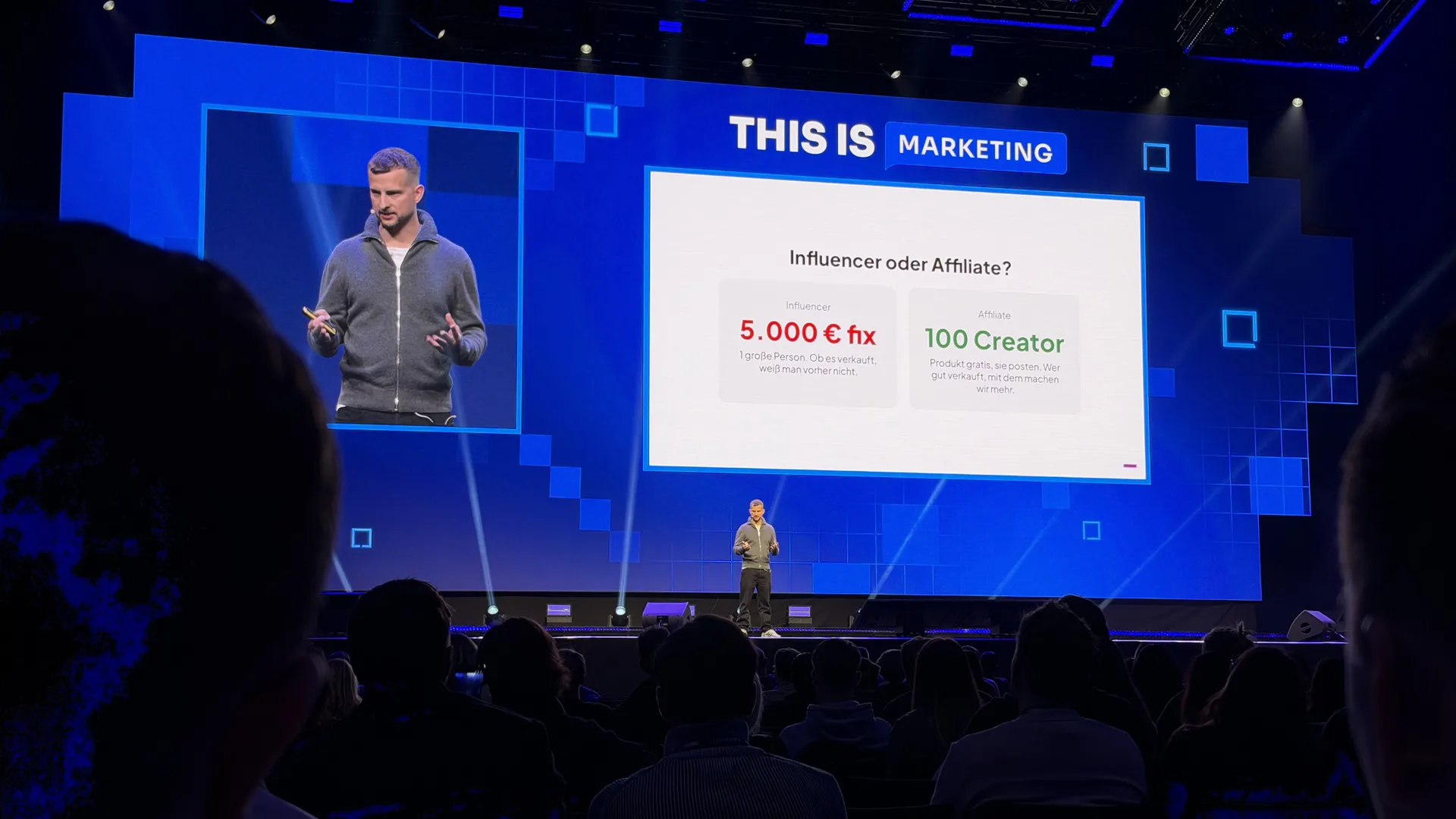
On Wednesday, 12 August 2026, marketer UX took part in the webinar “EU AI Act erklärt” (“The EU AI Act explained”) by the Cologne law firm WBS.LEGAL. Prof. Christian Solmecke opened by showing where AI is already causing harm today. Lawyer Moritz Gielen then explained what the EU's AI regulation has required since 2 August 2026 and answered questions from participants. WBS.LEGAL issued us a certificate for taking part, and the firm later sent out a detailed FAQ.
For us as an agency, one part matters most: the labelling obligation under Article 50. It affects anyone who uses AI to create images, videos, voices or texts for the public. Below is what we took away. We checked every statement against the legal text and the European Commission's pages, as of 16 November 2026. This article is not legal advice. For your specific case, ask a lawyer.
What applies since when
The AI Regulation (EU) 2024/1689, known as the EU AI Act, has been in force since 1 August 2024. Its rules, however, apply in stages:
| Since | What applies |
|---|---|
| 2 February 2025 | Prohibited AI practices (Article 5) and AI literacy (Article 4) |
| 2 August 2025 | Obligations for general-purpose AI models, such as the models behind ChatGPT, Claude or Gemini |
| 2 August 2026 | Transparency and labelling obligations (Article 50) |
| 2 December 2026 | End of the transitional period for machine-readable marking in AI systems already on the market before. Plus a new ban on AI that generates realistic intimate images of real people without consent |
| 2 December 2027 | Obligations for high-risk AI under Annex III, for example in recruitment or credit checks |
| 2 August 2028 | Obligations for high-risk AI in products under Annex I, for example in medical devices |
Originally, the obligations for high-risk AI were due to apply from 2 August 2026. With the so-called Digital Omnibus, Regulation (EU) 2026/1744, the EU postponed them. This amendment has applied since 27 July 2026. The Omnibus did not postpone the labelling obligation. Content created before 2 August 2026 does not have to be labelled retroactively, as the European Commission's guidelines on Article 50 confirm.
The stages follow the regulation's risk-based approach: the higher the risk of a use case, the stricter the rules. Gielen explained it like this in the webinar: the same AI may pose hardly any risk when writing a book and a high one in medical technology. The European Commission shows the 4 levels as a pyramid:
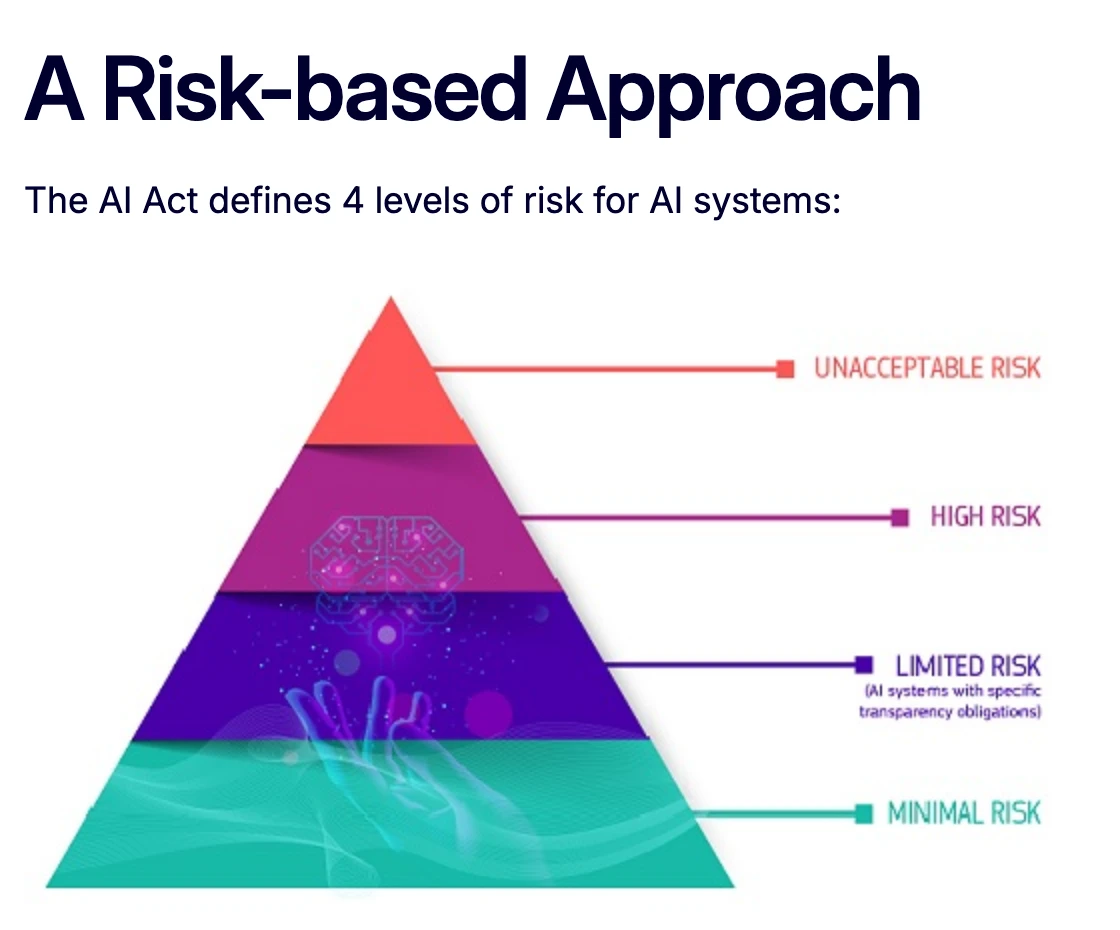
In the pyramid, the transparency obligations of Article 50 sit at the “limited risk” level. They can apply to any AI system, however, whatever level it otherwise falls into.
Provider or deployer: who is meant?
The regulation distinguishes 2 roles, and they determine which obligations apply to you. A provider develops an AI system or places it on the market under its own name, such as OpenAI, Anthropic or Midjourney. A deployer uses an AI system under its own professional responsibility. That is most companies, agencies and freelancers.
If you use ChatGPT, Claude or an image generator, you are a deployer. That also applies if you build your own workflows with your own prompts and automations on top of an existing language model. You only become a provider if you substantially modify a system or pass it on under your own brand. If someone on the team uses their private ChatGPT account for work tasks, WBS.LEGAL considers it likely that this is attributed to the company.
Purely private use is not covered. Gielen's example was a birthday invitation with an AI image. A private LinkedIn account that you use to post professionally does not count as private, however, because you want to reach the public with it.
These 4 cases require labelling
There is no general obligation to label every piece of AI content. Article 50 names 4 specific cases:
| Case | Who is affected | What to do |
|---|---|---|
| AI talks directly to people, e.g. as a chatbot or phone assistant | Provider | People must be able to tell they are talking to an AI, ideally in the first message or the first sentence. |
| AI generates images, videos, audio or text | Provider | Machine-readable marking, e.g. in the metadata. |
| Emotion recognition or biometric categorisation | Deployer | Inform the people affected. |
| Deepfakes and AI texts on matters of public interest | Deployer | Visibly disclose that the content was generated or manipulated with AI. |
For most companies, the last row is what counts. The machine-readable marking is usually handled by the tool you use. The visible label remains your job. Our graphic summarises the check in simplified form:

The order is deliberate. Anything used only privately or internally is not covered by Article 50. Everything else you check case by case.
Deepfakes: not just faces
When people hear deepfake, most think of a fake video of a politician. The regulation defines the term much more broadly in Article 3 point 60: image, audio or video content generated or manipulated by AI that resembles existing persons, objects, places, entities or events and would falsely appear to a person to be authentic.
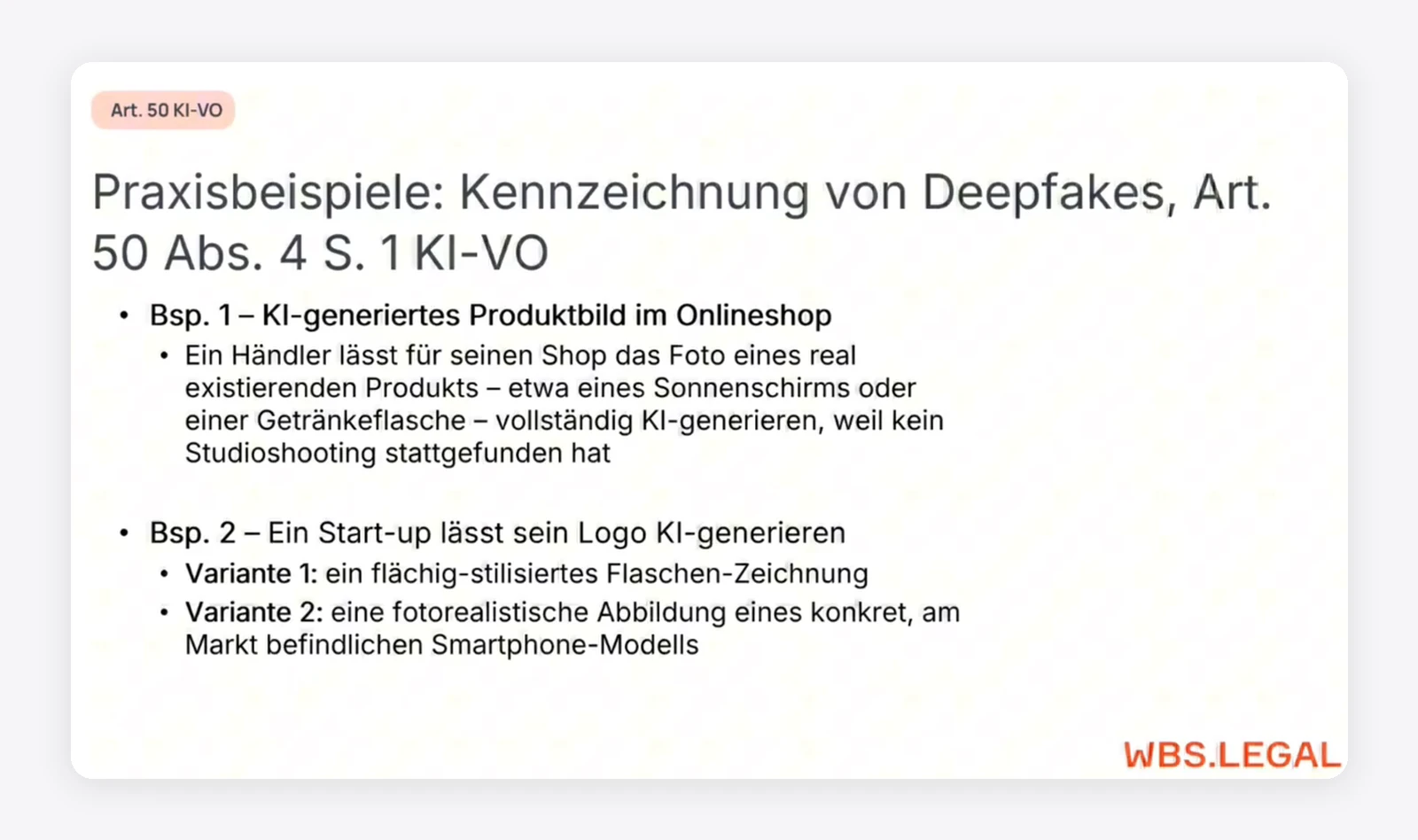
For marketing, this means a product photo can be a deepfake too. Gielen gave 2 examples:
- Product image in an online shop: a parasol or a drinks bottle, generated entirely with AI and so realistic that it looks like a studio photo, although there never was a photo shoot. This has to be labelled.
- Logo: if an AI logo shows a clearly drawn bottle, it is not a deepfake. If it shows a real product photorealistically, it can be one. On the slide, that was a specific smartphone model.
4 images we generated with AI for this article show how big the difference is. On the left, each motif looks like a real photo and therefore carries the EU icon “AI GENERATED”. On the right, the same motif is clearly drawn:

An AI voice generated from a real voice is covered as well, for example in a tutorial video on YouTube. With images, the result counts, not the tool. Removing a distracting person from a real photo in Photoshop is, in WBS.LEGAL's assessment, usually classic image editing. If the AI invents new, realistic image content instead, such as a different setting, labelling becomes more likely.
Clearly recognisable illustrations, cartoon characters or mascots are usually not affected. For evidently artistic, satirical or fictional works, a notice that does not spoil the experience is enough, for example in the credits. It is not yet settled whether entirely invented but realistic faces are covered. One question in the webinar addressed exactly this: the legal text refers to existing persons, while the Commission's guidelines read more broadly. In a dispute, a court decides.
AI texts: when the exception applies
For texts, the obligation is narrower. It only applies to texts published to inform the public on matters of public interest. And it does not apply if a human reviewed the text editorially before publication and a person or company holds editorial responsibility.
Gielen used 2 examples to show what “reviewed editorially” means:
- Read, but not checked: a press release is created with AI, someone reads it but does not check figures, quotes and sources. Then there is no editorial responsibility, and the text has to be labelled.
- Checked too late: an AI text goes online and is checked 2 hours later. What counts is the reader's first contact with the text. Until the review, it should have been labelled.
According to the WBS.LEGAL FAQ, a mere sign-off or a spell check is not enough. Classic product descriptions, SEO texts and press releases about your own products usually do not concern a matter of public interest in the firm's assessment. Editorial articles on social or political topics, by contrast, can be covered. Program code is not text in this sense, not even HTML or CSS.
That is why no article goes online at our agency without review. This text was also written with AI support and checked for content before publication, every source and every figure.
How and where to label
The regulation does not prescribe a font size, colour or position. The notice must be clear and distinguishable and recognisable at the latest at the first exposure. That leads to a few practical rules:
- Video: a notice at the start that stays on screen for a few seconds, or a watermark in the corner. For formats people join midway, such as livestreams or reels, a permanent label is safer.
- Text: below the headline or in a place an average reader sees when opening the page.
- Images: on the image itself. A general notice in the footer is only enough if it stays clear which image is meant. Thumbnails and preview images count as content in their own right.
- Check on mobile: if the label disappears on a phone through cropping or in the Instagram grid preview, it does not count.
- Metadata is not enough: Content Credentials based on C2PA help with machine-readable marking but do not replace the visible notice for deepfakes. A platform's own label does not automatically release you either.
Since June 2026, the European Commission has offered 3 official icons: “AI” for general AI involvement, “AI GENERATED” for content created entirely with AI and “AI MODIFIED” for content altered with AI. They are optional and free of charge. Your own clear wording, such as “Created with AI”, works just as well. The Commission itself stresses that using the icons does not on its own establish legal compliance.
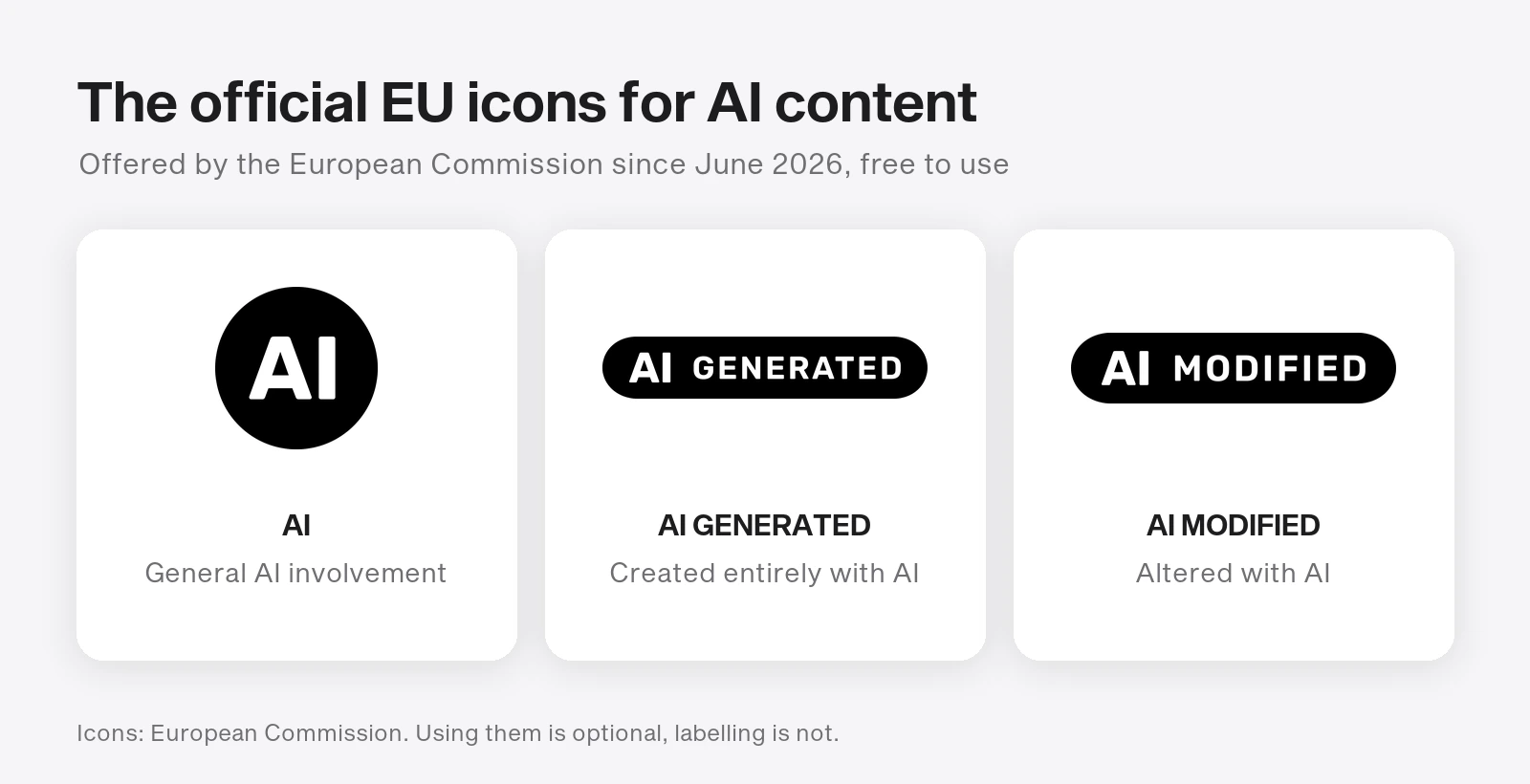
Icon or your own wording: what matters is that the notice is visible at first glance at the content.
Agency and client: who is responsible?
One question in the webinar came from an agency: does it have to change its terms and conditions if it uses AI for clients? Gielen's answer: responsibility stays with the agency, whether an employee writes the text or an AI does. Terms and conditions do not get you out of the duty to check. There are no mandatory clauses, but being open about where AI is involved builds trust.
The WBS.LEGAL FAQ assigns the roles like this: an agency producing with AI tools is a deployer itself. If the client publishes the content, the client may have obligations of its own. Between businesses, the risk can be allocated by contract, but the obligation towards the authority remains unaffected. If the agency delivers correctly labelled content and the client removes the label, the client is responsible for that. A notice in the legal notice or privacy policy does not replace the label on the content itself.
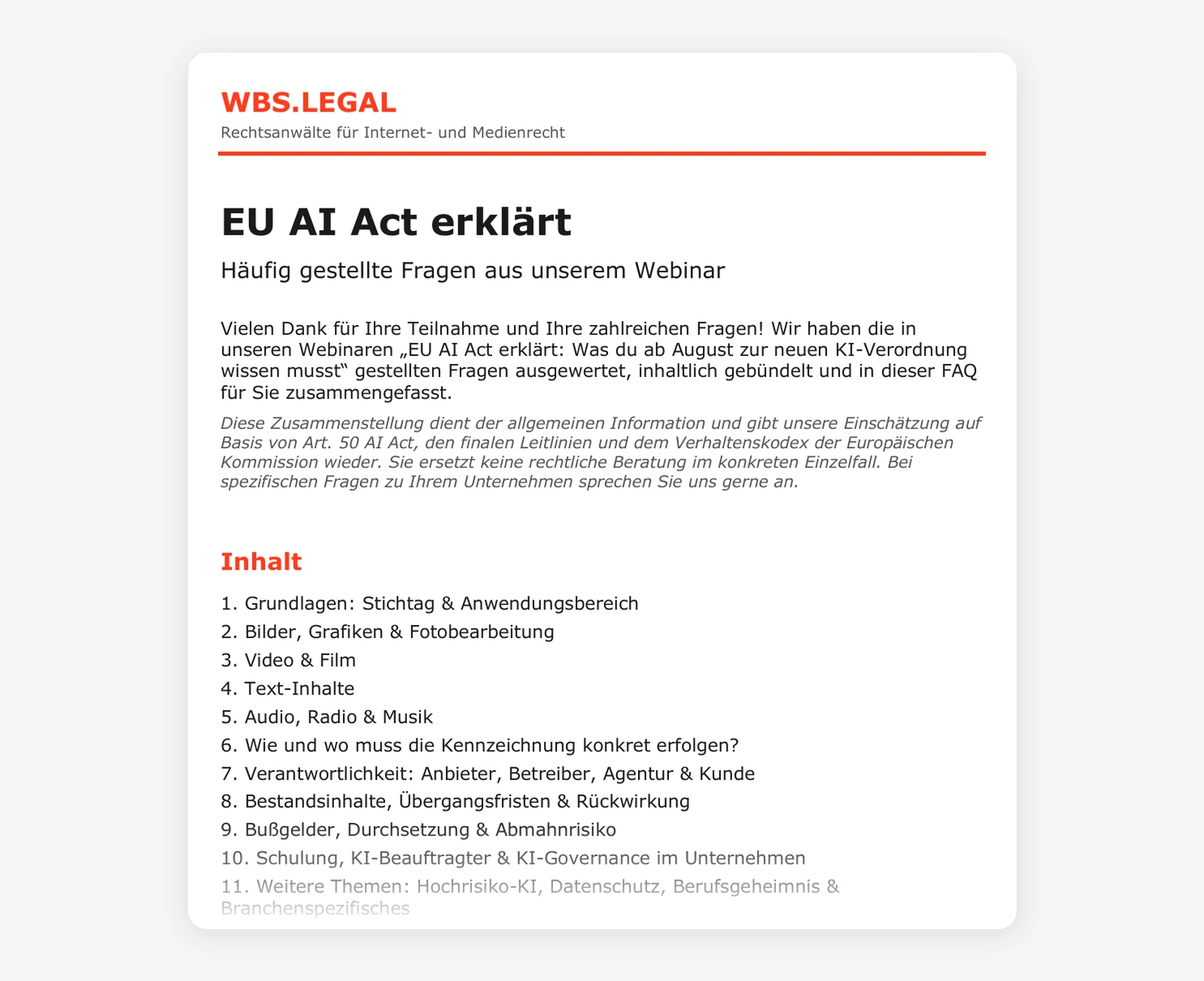
For our projects, this means: we state which images, videos and texts were created with AI and deliver them labelled wherever necessary.
AI literacy: who needs training
Article 4 has applied since February 2025. Since July 2026, the Omnibus has worded it somewhat more softly: providers and deployers take measures to support the AI literacy of their staff and of people acting on their behalf. They do not have to guarantee a specific level for every single person. The regulation does not provide for a separate fine for missing training. If a lack of knowledge leads to, say, missing labels, the fine for that violation applies.
The webinar also covered who this applies to. Gielen's answer: everyone who works with AI, for example IT, HR and marketing. Someone who delivers goods and does not use AI does not need training. Internal training is sufficient, the regulation does not require external certification. Nobody has to appoint an AI officer. It still makes sense to record who was trained on what and when. We use the WBS.LEGAL participation certificate for this ourselves.
Gielen considered internal AI guidelines just as important: which tools may be used, which data must not go in, how labelling works. This gives everyone on the team a clear framework.
Fines and warning letters
Under Article 99 of the AI Act, violations of the labelling obligation can cost up to 15 million euros or 3 % of worldwide annual turnover, whichever is higher. For small and medium-sized enterprises, the lower of the two amounts applies. The maximum of 35 million euros or 7 % concerns prohibited AI practices.
In Germany, the Federal Network Agency (Bundesnetzagentur) is in charge of supervision, as set out in the AI market surveillance act (KI-MIG) of 22 July 2026. It runs an AI service desk for companies with questions and answers. Gielen expects an approach similar to data protection: the authority gets in touch first and wants the violation remedied, and fines usually only follow if requests are ignored. That is his experience from the GDPR, not a promise. It can still get expensive, because dealing with an authority takes time, especially without documentation.
There is another risk many underestimate. In WBS.LEGAL's assessment, a competitor can also send a warning letter under German unfair competition law if labelling is missing. This has not yet been settled by the highest courts.
Checklist for your company
- Take stock: which AI tools do you use, who uses them, and for what?
- Chatbots and phone assistants: do they identify themselves as AI right at the start?
- Images, videos, voices: does something look real although it was made with AI? Then label it visibly, including product images and thumbnails.
- Texts: does a person check figures, quotes and sources before publication? Record this step.
- Agencies and service providers: agree in writing who labels what, and hand over labelled content.
- Training: train everyone who works with AI and document it.
- Policy: write an internal AI policy and update it regularly.
We heard Prof. Solmecke again in November, at the Synology Solution Summit in Düsseldorf. What he said there about the AI regulation and what we take from it for IT is in our recap of the Synology Solution Summit 2026.
If you have websites, images or texts created with AI and want to know where labelling is required, let's look at it together. You can read more about our work as a Webflow agency, or get in touch directly.
The example images and the background of the title image were generated with AI, the photo of Christian Kallinich is real. Where AI images look real, they carry the EU icon “AI GENERATED”. Slide and FAQ cover: WBS.LEGAL, screenshots. Image credits: risk pyramid as a screenshot from the European Commission website, © European Union, CC BY 4.0, cropped. EU icons from the European Commission, free to use.
FAQ
Do I have to label AI-generated images?
Yes, if they look real and resemble existing persons, objects, places or events. They then count as a deepfake under Article 3 point 60 of the EU AI Act, including a product photo. Clearly drawn illustrations, cartoon characters or mascots are usually not affected.
Do I have to label AI-generated texts?
Only texts meant to inform the public on matters of public interest. Even then, the obligation does not apply if a human reviewed the text editorially before publication and a person or company holds editorial responsibility. A mere spell check is not enough.
Who needs training under the EU AI Act?
Everyone in the company who works with AI systems, for example in marketing, IT or HR. Under Article 4 as amended in July 2026, providers and deployers take measures to support the AI literacy of these people. External certification is not required, internal training is sufficient. It still makes sense to record who was trained and when.